Supersmith hopes its latest innovation will help challenge perceptions of mobility aids
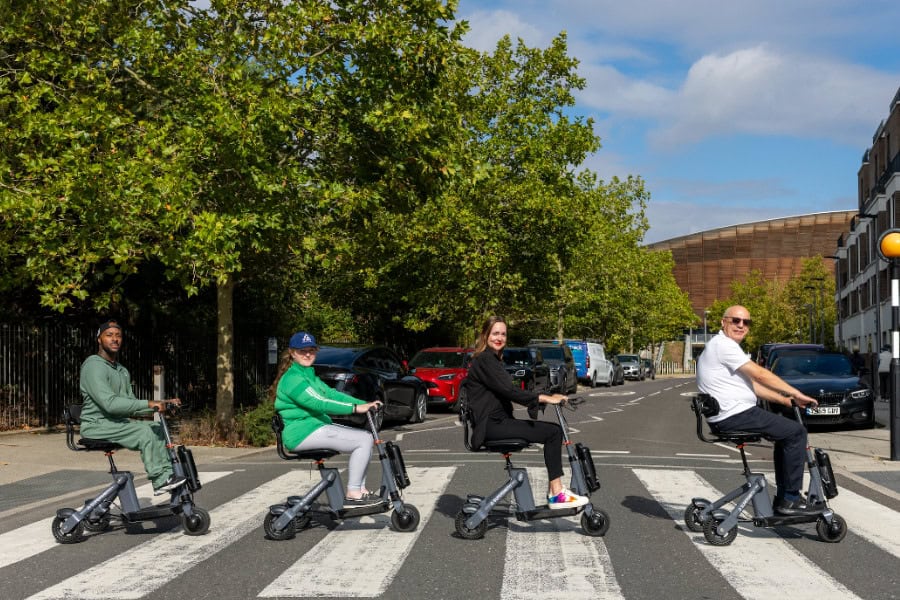
UK start-up Supersmith has launched the 3Scooter, a radically redesigned mobility vehicle that enables users to travel at almost eye level using technology inspired by Formula 1 active suspension, drones and e-bikes.
The scooter was put to the test at London’s Queen Elizabeth Olympic Park on 23 September, where the scooter’s stability and safety on hills, corners and curbs will be showcased at the site’s facilities.
The 3Scooter is a radically redesigned mobility vehicle intended to overcome both the physical and emotional barriers that can prevent people from getting out and experiencing the world around them.
Rather than placing its rider in the low seating position associated with a conventional mobility scooter, the 3Scooter allows users to travel at eye level.

The 3Scooter uses an intelligent active suspension and robotic control system designed to keep the vehicle stable as it travels and corners. The concept draws parallels to the active suspension technology that Formula 1 developed before such systems were prohibited from competition.
Behind the 3Scooter is entrepreneur Tom Morgan, whose determination to rethink mobility was shaped by the experiences of his sister and the problems she encountered with existing mobility products, including the risk of scooters tipping.
Tom commented: “Mobility issues shouldn’t mean missing out, or a product you’re too embarrassed to use. It shouldn’t mean staying at home, feeling isolated or having to accept that everyone around you will literally and figuratively look down on you.
“My sister’s experiences showed me that there were real engineering problems with traditional mobility scooters, particularly around stability and tipping. But as we started looking more closely, we realised there was another barrier that technology alone hadn’t addressed – stigma.
“When almost half of people tell us a mobility scooter could improve their quality of life, but they still wouldn’t use one, something has gone badly wrong. We need to rethink not only what mobility scooters can do, but what they represent.
“That’s why we wanted to create something completely different. We’ve taken ideas and technologies from Formula 1, drones, and e-bikes and applied them to personal mobility, allowing the rider to sit much higher while the scooter actively manages stability.
“We want people using the 3Scooter to be able to go to a gallery, a gig, a sporting event, a restaurant or meet friends and feel part of what is happening around them.”
The 3Scooter is also being positioned beyond the traditional mobility-aid market, with plans for it to be stocked at department stores and provided for use at major London attractions.
Victoria Jenkins, fashion designer and Supersmith ambassador added: “For too long, mobility products have been designed as medical equipment first and something people might actually aspire to own second.
“Why shouldn’t mobility design be innovative and exciting? Why shouldn’t it belong in the same conversations as automotive design, fashion and technology?
“The 3Scooter isn’t about asking people with mobility difficulties to fit around the world as it is. It’s about giving usgreater freedom to experience it on their own terms.”
The Bristol-based mobility innovator continues to highlight the “frequently overlooked” connection between mobility and mental wellbeing.
Stigma surrounding mobility scooters is causing people who need them to feel isolated and looked down on, according to recent research commissioned by Supersmith, which revealed how negative perceptions of mobility aids are affecting independence, confidence and social lives across Britain.
Its research found that over eight in 10 (81%) of people who use a mobility aid believe there is a stigma associated with mobility scooters, rising to nine in 10 (91%) in Greater London. Those aged 25-34 were the most likely to experience stigma.
More than half (57%) said they feel people “look down on” them for using a mobility scooter, while over half (54%) feel uncomfortable about being physically looked down on when using one.
The consequences extend beyond perception: more than half (52%) said they had been bumped or walked into while using a wheelchair or mobility scooter, and 45% said mobility issues leave them feeling isolated.
Close to half (48%) of people who need additional support to walk agree a mobility scooter could greatly improve their quality of life – but said they still would not use one, because of associated stigma.